Showing posts with label Israel. Show all posts

Feb 6, 2012

Da'as Torah: The Fall Of the Charedi Giant

Image: http://www.theyeshivaworld.com


The recent escalation of Charedi violence in Bet Shemesh and the issue of Jewish leadership has been on my mind constantly.
I am troubled by some of the cultural norms in the Orthodox community which seem nothing short of primitive. Where people who are fathers and husbands spend their day assaulting and spitting at members of neighboring communities.
Tell me it is the extreme. Tell me the majority of Charedim don't support the violence. And I will ask you in return: "Then where in the world are they? Why aren't the 'normal' charedim protesting this violence?"


Don't tell me that the protests in Israel represent only the most extreme elements of Charedi society.
Don't tell me that most charedim don't support it.
Don't.


When 9/11 happened, Dr. Zuhdi Jasser expected the Muslims to demonstrate by the thousands all over the world proclaiming their protest to violence and terror.
Instead there was deafening silence. No protests. No shouts. No denouncing.
That left the world with the conclusion that the terror represents Islam.

The fact that Charedim and their leaders aren't denouncing this extremist behavior, means by default that they are supporting it.
The fact that the educators in these state funded schools are given the freedom to preach all the fanatical and fundamental hate-speech and rhetoric that comes to their minds encourages silent support for the extremists.

I went to a shiur yesterday by a charedi female seminary speaker. She speaks at the MOCH (Modern Orthodox-Charedi) seminaries. MOCH seminaries are ones which accept Modern Orthodox students, but employ a CHaredi faculty and hope to convert the student body from Modern to Charedi. Some seminaries of this category are: Michlala, Sharfmans, Midreshet Tehillah, Darchei Binah, Neveh, Tomer Devorah... fill in the blank

Anyhow, I have developed an aversion for seminary speeches throughout my life, but I kept on hearing how good friends of mine, who seemed to be quite smart and intellectual raving about her brilliance.
I thought I might have been quick to judge and perhaps not all speakers from a certain religious spectrum spoke about the same things in the same way the entire time, so I went to the speech.
And needless I should have never doubted myself on that matter. The speaker was standing there fire and brimstone shrieking the walls down about the gashmius in America and how people went to Costco to buy stuff in bulk and then had so much stuff that they couldn't connect with God.
She drew a black dot on a paper and held it up and then told people that they see the dark dot because people tend to focus on the darkness. I wanted to tell her that if she took a black paper and drew a white dot., people would notice that, because the contrast is what is visible. I did not. But no one seemed to have a problem with what she said.
I was standing there in total awe. The room was packed with women in their mid to late twenties; women, who were university educated, most of them going for their graduate degrees. They were in touch with the world, products of YU, and yet, they were totally enthralled in the speech. I thought I was losing my marbles.
In the future, I will think twice before changing my opinion of 'spiritually uplifting' speakers.

If you listen to speeches of the Agudah, which is not considered extreme in the Charedi world, but is representative of the majority of Charedi institutions across America, you will hear speeches which reflect a society which is almost barbaric: Rabbis screaming and ranting against the internet, against texting, against email YEMACH SHEMAM.... Some of the speeches from the most recent convention can be accessed here.
The speaker refuses to put the blame on fathers for neglecting their children. The internet is to blame for that. As if before the internet, all men were perfect attentive fathers. As if the total elimination of the internet would institute blissful family life. As if all troubles of the community can be blamed on two external factors: texting and the internet.
Is that normal?
Do I want to belong to a community where a person spewing such ideas is regarded as a spiritual leader?

Do I want to belong to a community where the 'mainstream' magazines will exclude all pictures of women to the extent that an onlooker browsing through one of the publications would assume that Orthodox Jewry has only men in its constituency?

Rabbi Slifkin mentioned in his speech that the beginning of Daas Torah was established when Chassidim agreed to join the Aguddah on condition that the ruling of their rabbis wouldn't be questioned and it would need no justification.

And another question is: who is controlling the situation? Is it the rabbis and the so called da'as torah? Or is there an entire mafia manipulating the rabbis to control the press, the materials taught in classes and the dresses worn on the street?

Rabbi Aaron Lichtenstein wrote a phenomenal piece about the meaning of a Torah leader and Da'as Torah. If you are short on time, at least read his conclusion on the last page. And don't leave this blog without sharing your thoughts below.


Daat Torah Lichtenstein

Aug 25, 2011

No End to the Madness


Image: http://images.travelpod.com/

It saddens me to say this, but the community of Orthodox Jews in Israel is simply out of hand. 
In addition to the restrictive dress, prescribed behavior, now the charedi community sees shopping in the market "immodest and immoral."

For more information, see the following article. 

Jun 29, 2011

How Likely Is A Palestinian State By August 2011?


Image: http://www.enduringamerica.com/

What do you think about the likelihood of the Palestinians having their own independent state: ever, in August 2011 (according to Fayyad), after the UN votes in September (Although there is a likely US veto), ever?
Why?

Two interesting articles: Poll:

1) PA Arabs Would Chance Confrontation if State is Declared by David Lev


2) Fayyad: UN's 'PA State' Symbolic Only by Chana Ya'ar


May 26, 2011

Mar 31, 2011

Q & A

Feb 4, 2011

Is the Publicity Harming Gilad?

 GSS Head: Public Pressure Encouraged Hamas to Keep Shalit
by Hillel Fendel GSS: Public Endangered Shalit

Yuval Diskin, respected chief of Israel’s Security Agency (Shabak), says that the misguided, open-ended public support for Gilad Shalit ended up hurting him. He said that when he traveled to Egypt in 2009, at the end of Ehud Olmert’s term as prime minister to finalize a deal for Shalit, “the Hamas people in the delegation didn’t want to stop upping their demands at any point. They knew with certainty that no matter condition they would set, the public pressure [in Israel] would force us to accept it. At a certain point, I understood that this had become a slippery slope.”

For much of 2009, Israel was divided by the controversy over what price to offer for Shalit’s return. Many on the left said Shalit had been sent by the IDF and that it was therefore Israel’s responsibility to release even 1,000 terrorists or more for his return. Others said that the release of so many murderous terrorists was a price Israel could not afford to pay.

Back in July 2009, taking the approach that Yuval Diskin took this week, Moshe Feiglin of the Likud’s Manhigut Yehudit (Jewish Leadership) faction wrote, “We can safely say that whoever demands to free Gilad ‘at any price’ is actually sentencing him to death. I hope that I am wrong, but the real meaning of ‘any price’ is that there is no price. The terrorists understand that time is on their side. The more cruel they are, the more they conceal information, and even if they, G-d forbid, murder their captive and bargain for his body, the price that they will exact from Israel will only rise.”

Diskin was speaking last night at a memorial ceremony for the long-time editor of Yediot Acharonot, Dov Yudkovsky. His term in office will end this May, and by law he may not enter politics for three years afterwards.

Diskin also explained that Anat Kam and Ha'aretz journalist Uri Blau, who collaborated in the publishing of secret IDF documents, had “crossed a red line in doing so. It’s one thing to write an article, but to publish the documents themselves was beyond the pale… When we saw that there had been a leak from the army, we suspected that this was just the tip of the iceberg – and we were not mistaken.”


~~Arutz Sheva

Jan 12, 2011

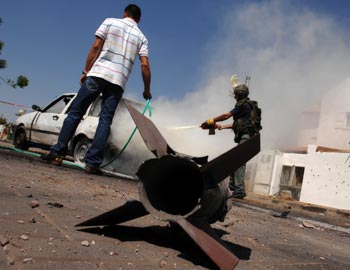
Sticks and Stones will Break my Bones but Quassams Will Never Harm my Spirit

Image: http://www.btselem.org/
Sderot. Yup, the city which took 10000 Quassam rockets over the past six years. We saw the playground which was built in a bomb shelter so that the kids will have the opportunity to play uninterrupted and as children. Sderot has the fifteen second rule. When a bomb is shot, the siren goes off and the habitants have fifteen seconds to get to a bomb shelter. How could parents allow their children play outside in such circumstances. The Hesder Yeshiva of Sderot is one of Chizuk to the city. The yeshiva has 300 passionate guys, and they are all about defying the enemy and prosperring despite the attacks. On the roof of the Yeshiva, there is a huge Menorah made of Quassam rockets which has otrches lit in the center of the city to strengthen the surrounding community. The campus and Beit Midrash are beautiful. It was really moving to see such tremendous development. 

Nov 29, 2010

Censorship Never Ends


Rabbonim Urge Public to Block 'Chareidi News Lines'


by Yated Ne'eman Staff


Gedolei Yisroel, including Maran HaRav Yosef Sholom Eliashiv shlita, are promoting a "tikkun godol" in response to one of the stumbling blocks of our day and age: home phone lines with access to numbers that have a corrupting impact and have claimed many victims.


In their public notice, maranan verabbonon warn against one of the great spiritual threats of today: "chareidi news lines," which fill their listeners with vapid messages and negative contents rife with loshon hora. These phone lines also present perverse worldviews and blatant disrespect for rabbonim, talmidei chachomim and gedolei Torah.


Roshei yeshivas, roshei kollelim, rabbonim and public figures have long warned against these phone lines, calling them a blight that destroys the Jewish soul by propagating loshon hora and blurring the boundaries between sacred and profane, between pure and tainted and through an atmosphere of levity that undermines aspirations to grow in Torah and yiras Shomayim.


Both the operators of these phone lines and those who collaborate with them make it their point to engage listeners in empty prattle, while generating dubious reports that are a world away from the hallowed halls of the beis medrash.


Rabbonim are even warning against chronic addiction to these phone lines, which pose a threat to any home founded on Torah and yir'oh, not to mention the high cost of listening to them.

Aug 30, 2010

Son of Hamas


Over the weekend I read a book named "Son of Hamas". It is one of the most eye-opening, thought provoking, emotionally wrenching books I have ever read. It gave me a fresh perspective on the Israeli-Palestinian conflict, displaying the situation in more grays than definitive black and white, as most of the world sees it. I recommend it to everyone, absolutely everyone and would love to hear what you think.

The book is written by Mosab Hassan Yousef, the son of Sheikh Hassan Yousef, one of the seven founders and leaders of Hamas. The book is an autobiography depicting his life journey, from a zealous Hamas activist to one of the most valuable spies for the Shin Bet in Israel. I was riveted and glued to the book the entire weekend. I could not focus on anything else. 

Yousef brings the human dimension into the conflict questioning the goals, and the means used to reach goals. He struggles with the idea of losing life over land, of losing sight of the bigger picture of peace and sovereignty for the details of whose side kills more people.

I do not want to spoil the book for you, however,  I would like to quote two paragraphs that shook me up. 

"…And the Israelis, unable to find and arrest the violent young militants, continued to pursue soft targets like my father. I think they figured that since my father was a leader of Hamas., which was carrying out these attacks, his imprisonment would put a stop to them. But they never made an effort to find out who or what Hamas really was. And it would be many painful years before they would begin to understand that Hamas was not an organization as most people understood organizations., with rules and a hierarchy. It was a ghost. An idea. You can't destroy an idea; you can only stimulate it. Hamas was like a flatworm. Cut off its head, ad it just grew another."
(Son of Hamas, pp.57-58)


In the final chapter of his book, Yousef wirtes:

"I had money, power, and position in my former life, but what I really wanted was freedom. And that meant, among other things, leaving behind hate, prejudice, and a desire for revenge. 
The message of Jesus--love your enemies--is what finally set me free. It no longer mattered who my friends were or who my enemies were; I was supposed to love them all. And I could have a loving relationship with a God who would help me love others. 
Having that kind of a relationship with God is not only the source of my freedom but also the key to my new life."
(Son of Hamas, p. 249)

In my opinion, the reason Yousef ultimately converted to Christianity, because to him, that symbolized a relationship of love, peace and kindness, despite its bloody past. He was raised in the conflict, where Jews and Muslims killed each other in the name of the Torah and the Qu'aran. He wanted out.

Okay, I'll leave it here. Would love to hear your thoughts and discuss this book with someone. 

Image: http://files.tyndale.com/thpdata/images--covers/500%20h/978-1-4143-3309-0.jpg
Also, you could check out the SON OF HAMAS blog

Aug 24, 2010

You Can Free Gilad


Why don't we campaign for Gilad Shalit like we did for Soviet Jewry?

Can we get 1 million Rosh Hashanna cards to Gilad Shalit delivered to
the UN and DEMAND that they be delivered to him?
Even as a PR stunt, it might just shift something?

I wrote about this on my blog,
http://thinkingtorah.blogspot.com/2010/08/what-can-we-do-for-gilad-shalit.html,
and the response has been impressive.
Bnei Akiva Australia and the Jewish Community in Dallas have already
taken this on.

How about your community, school, office or shul?

Join the campaign - Join the Facebook group (link) or just send a Rosh
Hashanna card to Ban Ki Moon demanding that it be delivered to Gilad,
and that he get visitation rights by the Red Cross.

Hoping for Gilad's freedom - soon!

Alex Israel

Aug 23, 2010

It Is Difficult to Be Moral All The Time

We have been raised with the notion that the IDF is the most moral army in the world.
Although it is impractical to expect perfection, it still pains my heart to hear that fellow Jews could treat other human beings with disrespect.
I am not sure what to make of this article and of what stance to take when there is injustice of this kind.

http://gu.com/p/2j6z9

Ha'aretz
Israeli army's female recruits denounce treatment of Palestinians
Harriet Sherwood

Aug 17, 2010

Why is Israel responsible for Nuclear Iran?

Russia is helping Iran build its nuclear reactor in Bushehr, Iran.


If the nuclear plant isn’t attacked within the next few days, Iran will be better equipped to achieving nuclear capabilities.


In my opinion, the reason Russia provides Iran with aid in the nuclear war, is to support Irans' fight against the United States and the Democratic West.


Nuclear Iran does not pose a danger to Israel alone. By acquiring nuclear weapons, Iran will create a nuclear umbrella which will strengthen world terrorism. Weapons can reach Europe as well as Israel, and with time, weapons will reach the USA as well.


Why is the world waiting for Israel to react?

Why is the UN so silent now when the world is in physical danger? Where is the same UN that comes out with multitudes of resolutions when Israel merely tries to defend itself?


Source: Haaretz Service


Israel is unlikely to attack Iran's nuclear reactor in Bushehr, which will soon be online, former U.S. envoy to the United Nations John Bolton told the Fox Business Network on Monday, adding that the Russian-built facility represents a major step forward for Iran's nuclear weapons aspirations.


Satellite image of the Iranian nuclear reactor at Bushehr, January 3, 2002

Photo by: Getty

 http://www.haaretz.com/news/diplomacy-defense/ex-u-s-diplomat-israel-unlikely-to-strike-iran-nuclear-plant-1.308578


Russia said Friday that it will begin loading nuclear fuel into the Bushehr reactor, Iran's first atomic power station, on August 21; this is an irreversible step toward the launch of the Bushehr plant after years of delays.

Russia agreed in 1995 to build the Bushehr plant on the site of a project begun in the 1970s by German company Siemens, but delays have haunted the $1 billion project and diplomats say Moscow has used it as a lever in relations with Tehran.

The United States has criticized Moscow for pushing ahead with the Bushehr project at a time when major powers including Russia are pressing Tehran to allay fears that its nuclear energy program may be geared to develop weapons.

But Western fears that the Bushehr project could help Iran develop a nuclear weapon were lessened when Moscow reached an agreement with Tehran obliging it to return spent fuel to Russia. Weapons-grade plutonium can be derived from spent fuel rods.

Speaking to Fox on Monday, Bolton said that Israel was unlikely to attack the Bushehr reactor, saying that "Israel's got a problem."

"Once the fuel rods are inserted into the reactor and attack on the reactor would almost certainly release radiation into the atmosphere, given where Bushehr is located right on the Persian Gulf possibly into the water as well," Bolton said, adding that "from Israel's point of view if they were going to do anything militarily about Bushehr you got a few days until the fuel rods are inserted."

The former UN envoy also said Israel would not attack the reactor since it was interested in the bigger picture of Iran's nuclear aspirations, saying that Israel has "the rest of Iran's nuclear program, the Iranian enrichment facility and so on to worry about too and I don't think Israel has the luxury to attack in the next few days, wait a few months and attack again."

In the interview, Bolton also said that the completion of the reactor was a "significant victory for Iran."

"They will be beginning the process of brining online a 1000 megawatt reactor. When it becomes fully operational the spent fuel coming out of the reactor will be plutonium which could be reprocessed chemically and used for nuclear weapons," Bolton said.

The former ambassador to the UN added that Iran was "on the verge of achieving something that Saddam Hussein was not ale to achieve, Bashar al-Assad in Syria was not able to achieve and that's getting a second route to nuclear weapons."

"It’s a very very significant step forward for the Iranian nuclear program," Bolton said.

Aug 5, 2010

"DAWN" Elie Wiesel

Last night I read “Dawn” by Elie Wiesel. Despite my fatigue, I stayed up into the late hours of the night captivated by the beautiful words Wiesel used to compose the novel that raises questions of existence and meaning of war.

The book is about a young Jewish man Elisha who survived the Holocaust and was recruited to Israel as a fighter for the freedom of Zion from the occupation of the British Mandate. The British captivated an Israeli and sentenced him to death by dawn. The Zionist resistance took a British Hostage and threatened to execute him if the Jewish fighter was not released. The British did not concede, and Elisha, the young boy, was chosen from the entire resistance to murder the British Officer. The book is dedicated to the emotional turmoil Elisha experiences in the process of becoming a murderer.


It is chilling to think of the comparison between the Israeli resistance in 1948 and the Hamas movement today. How are they different? Both organizations used terror as a means to achieve their end.

I think there is one clear difference, which my next post will be about.


Below I copied an excerpt from the book that made me cry.

“I had met Catherine in Paris in 1945, when I had just come from Buchenwald, that other magical spot, where the living were transformed into dead and their future into darkness. I was weakened and half starved. One of the many rescue committees sent me to a camp where a hundred boys and girls were spending their summer vacation. The camp was in Normandy, where the early morning breeze rustled the same way it did in Palestine.
Because I knew no French I could not communicate with the other boys and girls. I ate and sunbathed with them, but I had no way of talking. Catherine was the only person who seemed to know any German and occasionally we exchanged a few words. Sometimes she came up to me at the dining-room table and asked me whether I had slept well, enjoyed my meal, or had a good time during the day.
She was twenty-six or –seven years old: small, frail, and almost transparent, with silky blonde, sunlit hair and blue, dreamy eyes which never cried. Her face was thin but saved from being bony by the delicacy of her features. She was the first woman I had seen from nearby. Before this—that is, before the war—I did not look at women. On my way to school or to the synagogue I walked close to the walls, with my eyes cast down to the ground. I knew that women existed, and why, but I did not appreciate the fact that they had a body, breasts, legs, hands, and lips whose touch sets a man’s heart to beating. Catherine revealed this to me.
The Camp was at the edge of a wood, and after supper I went walking there all by myself, talking to the murmuring breeze and watching the sky turn a deeper and deeper blue. I liked to be alone.
One evening Catherine asked if she might come with me, and I was too timid to say anything but yes. For half an hour, an hour, we walked in complete silence. At first I found the silence embarrassing, then to my surprise I began to enjoy it. The silence of two people is deeper than the silence of one. Involuntarily I began to talk.
“Look how the sky is opening up,” I said.
She threw back her head and looked above her. Just as I had said, the sky was opening up. Slowly at first, as if swept by an invisible wind, the stars drew away from the zenith, some moving to the right, others to the left, until the center of the sky was an empty space, dazzlingly blue and gradually acquiring depth and outline.
“Look hard,” I said; “let’s go on walking.”
As we walked on I told her the legend of the open sky. When I was a child the old master told me that there were nights when the sky opened up in order to make way for the prayers of unhappy children. On one such night a little boy whose father was dying said to God: “Father, I am too small to know how to pray. But I ask you to heal my sick father.” God did what the boy asked, but the boy himself was turned into a prayer and carried up into Heaven. From that day on, the master told me, God has from time to time shown himself to us in the face of a child.
“That is why I like to look at the sky at this particular moment,” I told Catherine. “I hope to see the child. But you are a witness to the truth. There’s nothing there. The child is only a story.”
It was then for the first time during the evening that Catherine spoke.
“Poor boy!” she exclaimed. “Poor boy!”
She’s thinking of the boy in the story, I said to myself. And I loved he for her compassion.
After this Catherine often went walking with me. She questioned me about my childhood and my more recent past, but I did not always answer. One evening she asked me why I kept apart from the other boys and girls in the camp.
“Because they speak a language I can’t understand” I told her.
“Some of the girls know German,” she said.
“But I have nothing to say to them.”
“You don’t have to say anything,” she said slowly, with a smile. “All you have to do is love them.”
I didn’t see what she was driving at and said so. Her smile widened and she began to speak to me of love. She spoke easily and well. Love is this and love is that; man is born to love; he is only alive when he is in the presence of a woman he loves or should love. I told her that I knew nothing of love, and I didn’t know it existed or had a right to exist.
“I’ll prove it to you,” she said.
The next evening, as she walked at my left side over the leaf-covered path, she took hold of my arm. At first I thought she needed my support, but actually it was because she wanted me to feel the warmth of her body. Then she claimed to be tired and said it would be pleasant to sit down on the grass under a tree. Once we had sat down she began to stroke my face and hair. Then she kissed me several times; first her lips touched mine and then her tongue burned the inside of my mouth. For several nights running we returned to the same place, and she spoke to me of love and desires and the mysteries of the heart. She took my hand and guided it over he breasts and thighs and hands that could set a man’s heart to beating and turn his blood to fire.
Then came the last evening. The month of vacation was over and I was to go to Paris the next day. As soon as we had finished supper we went to it for the last time under the tree. I felt sad and lonely, and Catherine held my hand in hers without speaking. The night was fair and calm. At intervals, like a warm breath, the wind played over our faces. It must have been one or two o’clock in the morning when Catherine broke the silence, turned her melancholy face toward me, and said:
“Now we’re going to make love.”
These words made me tremble. I was going to make love for the first time. Before her there had been no woman upon earth. I didn’t know what to say or do; I was afraid of saying the wrong thing or making some inappropriate gesture. Awkwardly I waited for her to take the initiative. With a suddenly serious look on her face she began to get undressed. She took off her clothes and was completely naked before me.
“Take off your shirt,” she ordered.
I was paralyzed; there was iron in my throat and lead in my veins; my arms and hands would not obey me. I could only look at her from head to foot and follow the rise and fall of her breasts. I was hypnotized by the call of her outstretched, naked body.
“Take off your shirt,” she repeated.
Then, as I did not move, she began to undress me. Deliberately she took off my shirt and shorts. Then she lay back on the grass and said:
“Take me.”
I got down on my knees. I stared at her for a long time and then I covered her body with kisses. Absently and without saying a word she stroked my hair.
“Catherine,” I said, “first there is something I must tell you.”
Her face took a blank and anguished expression, and there was anguish in the rustle of the breeze among the trees.
“No, no!” she cried. “Don’t tell me anything. Take me, but don’t talk.”
Heedless of her objection I went on:
“First, Catherine,” I must tell you…”
Her lips twisted with pain, and there was pain in the rustle of the breeze.
“No, no, no!” she implored. “Don’t tell me. Be quiet. Take me quickly, but don’t talk.”
“What I have to tell you is this,” I insisted: “You’ve won the game. I love you, Catherine… I love you.”
She burst into sobs and repeated over and over again:
“Poor boy! You poor boy!”
I picked up my shirt and shorts and ran away. Now I understood. She was referring not to the little boy in the sky but to me. She had spoken to me of love because she knew that I was the little boy who had been turned into a prayer and carried up into heaven. She knew that I had died and come back to earth, dead. This is why she had spoken to me of love and wanted to make love with me. I saw it all quite clearly. She liked making love with little boys who were going to die; she enjoyed the company of those who were obsessed with death. No wonder that her presence this night in Palestine was not surprising. (Dawn, Elie Wiesel, pp.41-43)

Jul 26, 2010

Why won't Abbas speak with Netanyahu?

http://www.haaretz.com/news/diplomacy-defense/u-s-presses-abbas-to-resume-direct-peace-talks-with-israel-1.304228

Can someone explain why it is so difficult for Abbas to meet with Netanyahu in direct peace talks?